Recovery & Performance with Red Light Therapy
Recovery and performance red light therapy is a gentle, non-invasive service for active people who want support between workouts, training blocks, physically demanding workdays, or recreational activity. It uses therapeutic red and near-infrared light to support muscle recovery and day-to-day readiness.
People often choose this treatment when they are managing post-workout soreness, muscle fatigue, heavy legs, active lifestyles, or recurring physical strain. It is not a replacement for rest, hydration, nutrition, or smart programming; it is an added recovery tool that may help the body reset between demands.
For this service, the simplest explanation is that red light therapy supports recovery capacity. It does not hack performance or erase the need for fundamentals, but it may help support the systems involved in muscle repair, soreness management, and training consistency.
At A Glance
Treatment type: Non-invasive performance and recovery light therapy
Best for: Post-workout recovery, muscle soreness, training fatigue, active lifestyles, and physical-demand recovery
Downtime: None expected
Sensation: Gentle warmth or minimal sensation
Session setup: Rest while the panel targets larger muscle groups or training-stressed areas
Eye protection: Provided and worn during exposure
Results: Cumulative with consistent use around recovery needs
Main goal: Support muscle recovery, reduce soreness, and help maintain consistent movement
What is red light therapy?
For recovery and performance, red light therapy is a non-invasive photobiomodulation treatment used to support active bodies between workouts, work demands, or periods of physical strain. It uses selected red and near-infrared wavelengths that are studied for their relationship to cellular energy, tissue repair, inflammation response, and muscle recovery.
The American Academy of Dermatology describes red light therapy, also called photobiomodulation, as a non-invasive treatment using red or near-infrared light. Professional treatment can provide stronger, broader, and more consistent exposure than many small at-home devices, which may matter when treating legs, back, shoulders, or other larger recovery areas.
For recovery & performance, red light therapy is commonly used to support:
Post-workout recovery
Muscle fatigue and soreness
Exercise-related strain
Active lifestyles
Everyday movement and mobility
Training consistency
General recovery between physical demands
How Red Light Therapy May Support Recovery
Training, sport, and physically demanding routines all create stress in the body. That stress is part of adaptation, but recovery has to keep pace. When recovery lags, people may notice soreness, heaviness, stiffness, reduced output, or difficulty staying consistent.
Red light therapy may support recovery by influencing cellular energy production, circulation, oxidative stress, and inflammatory pathways. These mechanisms are often discussed in relation to mitochondria, the energy-producing structures inside cells.
In plain language, red light therapy is not a performance shortcut. It is a recovery support that may help the body handle repeated physical demands when used alongside sleep, hydration, protein intake, mobility, smart programming, and rest.
A systematic review and meta-analysis on photobiomodulation for delayed-onset muscle soreness (DOMS) reviewed controlled studies examining light therapy after induced muscle soreness. The review reflects growing research interest in photobiomodulation as a recovery tool, while also showing that study design, dose, timing, and treatment parameters matter.
Benefits of Red Light Therapy for Recovery & Performance
-
After a workout, the body repairs stressed muscle tissue, clears metabolic byproducts, restores energy balance, and adapts to the training stimulus. Red light therapy may help support these natural recovery processes by encouraging cellular energy production and tissue repair.
For people who train consistently, better recovery can make it easier to maintain a routine. Red light therapy should not be seen as a shortcut around rest or programming, but it may be a useful addition for people who want extra recovery support between workouts.
-
Delayed-onset muscle soreness often appears 24 to 72 hours after unfamiliar or intense activity. It can make movement feel uncomfortable and may temporarily reduce strength, range of motion, and motivation to train.
Red light therapy may help reduce soreness by supporting a healthier inflammatory response and tissue recovery. Current research is promising, but not every study shows the same results. A randomized controlled crossover trial published in Frontiers in Physiology, for example, found that photobiomodulation at 808 nm did not improve biceps performance to exhaustion or delayed-onset muscle soreness in young adult women, which shows why dose, timing, population, and treatment design matter
-
Muscle fatigue can happen after exercise, long workdays, repetitive movement, or active routines. It may feel like heaviness, reduced strength, slower recovery, or a general sense that the body is not bouncing back as quickly.
Photobiomodulation has been studied as a potential support for muscle endurance and recovery, but the research is still evolving. A recent meta-analysis on pre-exercise photobiomodulation notes that its role as an ergogenic aid for sport performance remains controversial, while evaluating whether it may improve muscle endurance and recovery across different activity levels.
-
Recovery support is not only for competitive athletes. Recreational exercisers, runners, gym members, dancers, weekend hikers, active parents, and people with physical jobs can all experience soreness or fatigue that affects consistency.
Red light therapy can be built into a weekly routine to support readiness between training days or demanding workdays. Because it does not require downtime, it can be used without interrupting movement, work, or regular activities.
For active people, red light therapy can be one piece of a larger recovery strategy. Massage therapy may help with muscle tension, physiotherapy can support movement quality and injury prevention, mobility work can improve range of motion, and strength programming can help the body tolerate training demands. Chiropractic care, acupuncture, warmups, cooldowns, nutrition, hydration, and planned rest may also play a role depending on your goals.
What Makes Red Light Therapy Different from Other recovery tools?
Recovery tools work in different ways. Stretching and mobility work help maintain range of motion. Massage applies pressure to soft tissue. Heat can relax tight areas. Cold therapy may temporarily reduce soreness or swelling. Compression can support circulation and fluid movement.
Red light therapy works differently. It uses light energy to support cellular activity rather than relying on pressure, temperature shock, or medication. The treatment should feel comfortable and does not require physical manipulation of sore areas.
That makes red light therapy appealing for people who want a gentle recovery option they can use consistently. It may also complement other recovery strategies, including stretching, mobility work, massage, physiotherapy, acupuncture, chiropractic care, strength training, sleep, and nutrition.
What to Expect During a recovery & Performance Session
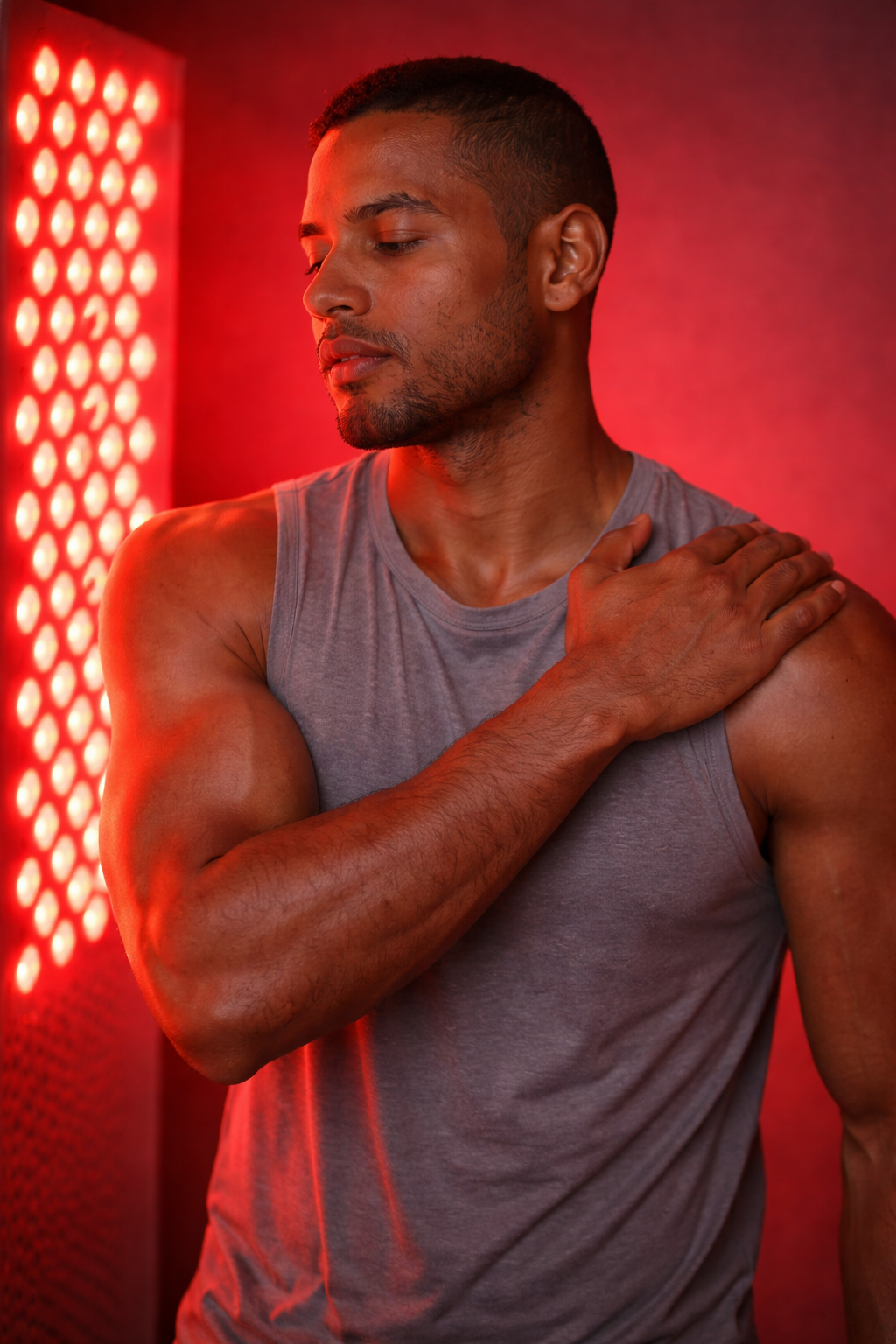
A red light therapy session is simple and comfortable. You lie comfortably on the treatment table while the red light panel is positioned above you and directed toward the body or the area you want to support. For recovery and performance, common focus areas may include the legs, back, shoulders, hips, knees, or other areas affected by training or physical activity.
Eye protection is required during treatment, and we provide it for you.
You may feel gentle warmth from the panel, but the treatment should not feel painful or hot. There are no needles, no medication, no electrical pulses, and no expected downtime.
After your session, you can usually return to your normal routine right away. Some people feel looser or more refreshed after a session, while others notice benefits gradually with consistent use.
Is Red Light Therapy Safe?
Red light therapy is generally considered low-risk when used properly, but recovery goals should not override injury awareness. Pain, swelling, weakness, or reduced performance that is sudden, severe, or worsening should be evaluated appropriately.
Speak with a healthcare provider before red light therapy if you are pregnant, have a history of cancer, have a light-sensitive condition, take photosensitizing medication, have an active infection, or have a medical condition affecting the area being treated.
Do not use red light therapy instead of medical care for severe pain, sudden swelling, suspected fracture, chest pain, blood clot symptoms, neurological symptoms, or pain after a major injury.
How Often Should You Do Red Light Therapy for recovery & performance?
The best schedule depends on your goals, training routine, sensitivity, and provider recommendations. Some people use red light therapy around training days, while others use it as part of a regular weekly recovery routine.
For recovery support, consistency is usually more important than intensity. Red light therapy is not about doing the longest possible session. It is about using appropriate treatment settings regularly and safely.
Why Device Quality Matters
For recovery and performance, device quality matters because active people often need consistent coverage over larger muscle groups. Wavelengths, power output, treatment distance, coverage area, and testing standards can all influence how well a session matches the goal.
Rouge Care, the red light therapy panel brand we use, describes its devices as patented and third-party tested. Rouge states that its newer G4 series includes eight red and near-infrared wavelengths, high-output 5W multichip LEDs, precision-engineered spacing, and smart controls with preset protocols for goals such as muscle recovery, wellness, skincare, sleep, and joint pain.
For training-related recovery, near-infrared wavelengths are especially relevant because they are commonly discussed in relation to deeper tissue and muscle-focused applications.
A professional panel can also cover larger areas such as legs, back, hips, or shoulders more evenly than many compact personal-use devices, which may be useful when the goal is recovery after sport, workouts, or physical work.
Red Light Therapy and Your recovery Routine
Red light therapy works best when it supports a well-rounded recovery routine. Depending on your goals, that routine may include sleep, hydration, protein intake, mobility work, strength training, warmups, cooldowns, massage therapy, physiotherapy, acupuncture, chiropractic care, and appropriate rest days.
A strong recovery routine may include:
Sleep, hydration, and protein to support repair and energy
Warmups, cooldowns, and mobility work to help reduce stiffness and support movement
Strength training and rest days to build capacity without overloading the body
Massage, physiotherapy, chiropractic care, or acupuncture when extra support is needed
For long-term performance, recovery is part of training. Red light therapy can be one simple tool that supports consistency, mobility, and readiness for your next workout, workday, or physical demand.
Who Is Recovery & Performance Red Light Therapy best For?
Recovery and performance red light therapy may be a good fit if you want support for:
Post-workout recovery
Muscle fatigue and soreness
Athletic performance support
Active lifestyles
Training consistency
Exercise-related strain
Everyday movement and mobility
General recovery between physically demanding days
It may not be the best standalone option for acute injuries, severe pain, major swelling, nerve symptoms, unexplained weakness, or conditions that require medical diagnosis. In those cases, red light therapy may still be supportive, but only as part of a broader care plan.
Red light therapy may also be useful for people already working with a trainer, coach, massage therapist, physiotherapist, chiropractor, or acupuncturist. Those supports can help with programming, mechanics, mobility, strength, tissue quality, or recovery planning, while red light therapy provides an additional non-invasive recovery layer.
The bottom line
Red light therapy is a gentle, non-invasive treatment that may help support recovery and performance by encouraging cellular energy production, muscle recovery, reduced soreness, and better day-to-day movement.
It is not a shortcut around sleep, nutrition, training structure, or rest. It is best understood as a supportive recovery tool that works with the body’s natural repair and adaptation processes.
For people who train regularly, live active lifestyles, or want to feel less fatigued after physical strain, red light therapy can be a simple addition to a recovery routine focused on consistency, mobility, and long-term performance.
Frequently Asked Questions
-
Red light therapy may help support muscle recovery by encouraging cellular energy production, tissue repair, and a healthier inflammatory response. Research on photobiomodulation has explored its use for exercise recovery, soreness, fatigue, and performance, though results vary depending on dose, timing, device type, and population.
-
Red light therapy may help reduce post-workout soreness for some people, especially when used consistently and with appropriate treatment settings. However, research results are mixed, so it should be viewed as a supportive recovery tool rather than a guaranteed soreness solution.
-
No. Red light therapy is designed to be comfortable after training or physical strain. You may feel warmth from the panel, but it should not feel painful, hot, or irritating.
-
Downtime is not expected. Most people return to work, training, or regular activities right away, depending on how their body feels and what they had planned.
-
Yes. Provided eye protection is worn during each session.
-
Red light therapy has been studied as a possible performance and recovery support tool, but it should not be described as a guaranteed performance enhancer. It may be most useful as part of a broader routine that supports recovery, consistency, and readiness to train.
-
Yes. For recovery and performance goals, red light therapy can fit into a plan that includes training structure, mobility work, massage therapy, physiotherapy, chiropractic care, acupuncture, strength programming, nutrition, hydration, and rest days. It works best when it supports the habits and treatments that help you recover, adapt, and stay consistent.
Sources
Rouge Care — Red Light Therapy Panels
Device information used for professional panel coverage, third-party testing, G4 wavelengths, output consistency, and muscle recovery presets.
https://rouge.care/Cleveland Clinic — Red Light Therapy: Benefits, Side Effects & Uses
Medical overview of red light therapy, potential uses, mitochondria/cellular energy context, benefits, limitations, and safety considerations.
https://my.clevelandclinic.org/health/articles/22114-red-light-therapyAmerican Academy of Dermatology — Is red light therapy right for your skin?
Professional overview of photobiomodulation, device strength, safety, and complementary use.
https://www.aad.org/public/cosmetic/safety/red-light-therapyPubMed Central — Effects of Photomodulation Therapy for Delayed Onset Muscle Soreness: A Systematic Review and Meta-Analysis
Systematic review examining photobiomodulation therapy for delayed-onset muscle soreness and recovery-related outcomes.
https://pmc.ncbi.nlm.nih.gov/articles/PMC12286287/Lasers in Medical Science / Springer — Can pre-exercise photobiomodulation improve muscle endurance and promote recovery?
Meta-analysis examining pre-exercise photobiomodulation, muscle endurance, recovery, and performance-related outcomes.
https://link.springer.com/article/10.1007/s10103-024-04079-yFrontiers in Physiology — Photobiomodulation Therapy at 808 nm Does Not Improve Biceps Brachii Performance to Exhaustion and Delayed-Onset Muscle Soreness in Young Adult Women
Randomized crossover trial showing mixed findings for photobiomodulation, muscle performance, and delayed-onset muscle soreness.
https://www.frontiersin.org/journals/physiology/articles/10.3389/fphys.2021.664582/fullStanford Medicine — Red light therapy: What the science says
Medical overview of photobiomodulation, red light therapy, clinical context, professional-use considerations, and current scientific limitations.
https://med.stanford.edu/news/insights/2025/02/red-light-therapy-skin-hair-medical-clinics.html
Clinically Reviewed by
Dr. Jackson Mann, Chiropractor
Clinical Director, Vancouver Red Light Therapy
Practicing Chiropractor at Electra Health, Downtown Vancouver
Dr. Jackson Mann provides clinical oversight for Vancouver Red Light Therapy’s treatment information and helps ensure our content is grounded in a thoughtful, wellness-focused perspective. As a licensed chiropractor with over a decade of experience in patient care, Dr. Mann brings practical insight into movement, recovery, mobility, tissue function, and musculoskeletal health.

Professional Registration: Registered Chiropractor, College of Complementary Health Professionals of BC
Licence Number: 002181
Practice Location: Electra Health, 970 Burrard Street, Vancouver, BC
For more information on Dr. Jackson Mann please visit the links below: